News (engl.)
"Future Leaders": participants from 25 countries attend leadership programme in Lörrach
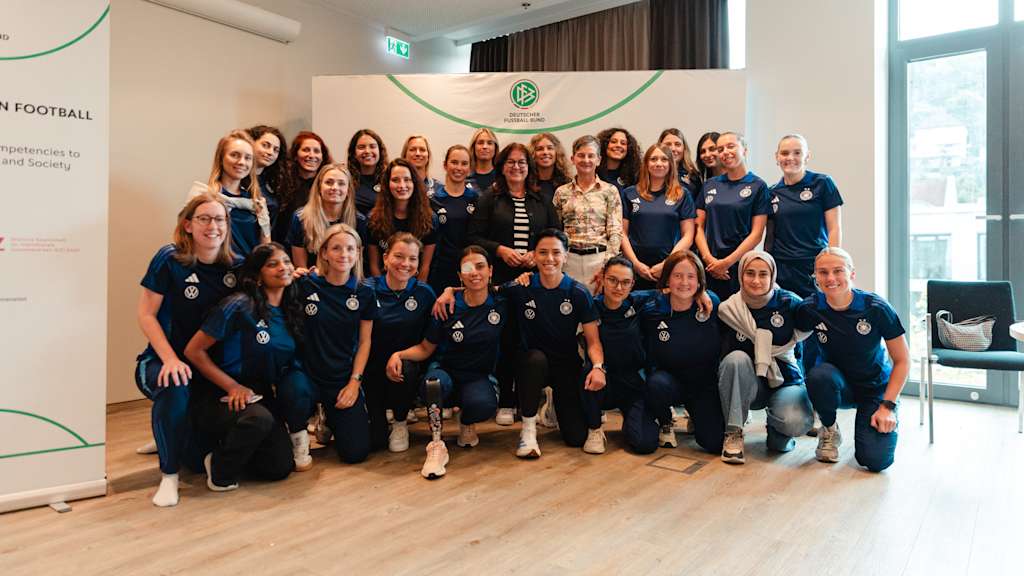
The UEFA Women's European Championship tournament was the fitting stage for young role models to meet – both on and off the pitch. As the participants of the "Future Leaders in Football" (FLF) leadership programme came to Basel to watch the Germany vs Denmark match, it became clear that what is needed are more women, in particular off the pitch, if we want to fully exploit the (social) force of football and lift the game to the next level. In impressive manner, the Future Leaders showed that they can be counted on to hold leading positions in football in the future.
"Programmes such as the FLF create a unique platform for international connections to grow beyond borders, backgrounds, and roles. The end of the workshop doesn't mean that the relationships built there will end, too. On the contrary – it's the beginning of a long-term and sustainable support network that enables women to lead, work together, and stay connected", says DFB General Secretary Heike Ullrich.
“Future Leaders in Football reflects our belief that developing strong leadership in the women’s game is not only a national priority, but a shared European responsibility. Programmes like the FLF create a unique space where international connections can grow—across borders, backgrounds, and roles. Strong networks are the foundation of strong leadership. These relationships don’t end when the workshop does. They are the beginning of a lasting support system that empowers women to lead, to collaborate, and to stay connected far beyond today,” said Heike Ullrich, General Secretary of the DFB.“ As we experience the momentum of the 2025 Women’s EURO in Switzerland and across Europe, this workshop seeks to carry that energy forward — by empowering the next generation of women shaping the future of football.”
Hosted by the DFB, its partner Volkswagen, the German Federal Ministry for Economic Cooperation and Development (BMZ) and the Deutsche Gesellschaft für Internationale Zusammenarbeit (GIZ), the FLF leadership programme – now in its sixth edition – is targeted towards young, up-and-coming female leaders working in football.
The FLF documents the DFB's continuing commitment to promoting equal opportunities for women in the game, as well as to increase the number of women in decision-making bodies. 25 participants from 25 countries came together in Lörrach, Germany, the great majority of them having been nominated by UEFA National Associations, where they are already holding various positions, from Marketing Manager to Head of Competitions and Referees to Senior Legal Counsel. As the program is also aiming towards the social power of football, a very enriching addition to the course are the further participants from the Sport-for-Development-Sector, working in other sports, civic society and NGOs, coming from India, Colombia, Iraq, and Egypt.
Over the years, the DFB and its partners have seen more than 90 Future Leaders in football successfully complete the course programme. As the DFB strategically focusses on promoting women in football, fostering their visibility and hence working towards equal opportunities in sport, the FLF program is a logical and fitting addition to a strategy aimed at strengthening women in football by way of the FF27 strategy and the "Female Brilliance" project, as well as promoting diversity in the area of volunteering and offering specific leadership-training to women about to hold executive positions.
"To bring about change, we need more women in football — not just for political and moral reasons, but for competence. If you do not push, you will never get change, you will remain part of a stuck structure. We need friction to be successful and develop. With this real progress can begin", says former Norwegian national team player and current (first female) president of the Norwegian Football Association Lise Klaveness. In addition to her, other renowned keynote speakers had accepted the DFB's invitation, including former Welsh national team player and current UEFA Vice-President Laura McAllister. To date, she and Klaveness are the only women on UEFA's Executive Committee, the highest decision-making body in European football. " The positive power of football has not yet been maximized, and with more women on decision making bodies, we can achieve that. Despite the progress, micro misogynies still exist and it's on everyone in football to create a space where female leaders are welcome. We need to normalize the fact that women and girls belong in football, on the pitch, as coaches, administrators and as leaders. Football is not just a sport for everyone, it must also be a sport that is governed by everyone, for everyone ", said Laura McAllister.
With their own unique style as leaders, both UEFA Executive Committee members are a testimony to one of the FLF program’s key messages: there is more than one way to be successful leader. The most important thing is to remain true to oneself and to lead authentically.
Nadine Keßler, 2013 European Champion and FIFA Women's World Player of the Year 2014, is now the Managing Director of Women's Football at UEFA. In her Q&A session at the FLF she said: "When we reach the point where every CEO has women’s football on their agenda without it even being a question, we will have made it. We have to grow the business case of women’s football and we need to ensure a return on investment. The current Women's EURO in Switzerland is a big step into the right direction."
Alexandra Popp, a true leader on the pitch, shared some inspiring insights into her career and mindset. “For me, leadership means authenticity - conveying what you really feel. Where you have the feeling: This is right, this feels good," said the German ex-international and 2016 Olympic gold medal winner. "Of course, this also includes a certain body language - radiating it in such a way that you don't feel you have to say anything else but express a lot through your posture and attitude alone: drawing people in, perhaps even intimidating your opponents a little. But the most important thing is to stay true to yourself, stay true to your path - and not feel like you have to do something special or crazy."
In addition to the sessions delivered by those influential women in football, the focus was on the theoretical leadership sessions prepared in cooperation with the Loughborough University, ranging from modules on personal leadership philosophy, to mutual peer consulting and effective communication to navigating challenges that women in sport, no matter their background or position, invariably encounter. Sports moderator Jessica Libbertz furthermore added to the program by offering many useful pieces of practical advice on how to communicate successfully.
All in all, the FLF once again managed to create a setting in which the participants felt safe and welcome, where they could openly talk about their leadership challenges while receiving valuable guidance on how to best and most authentically lead in future leadership positions. One thing is certain: these are 25 future leaders, 25 gamechangers, who will definitely leave their mark in football. The FLF gives hope for the future of football. After five full and inspiring days, the sixth edition of the “Future Leaders in Football” leadership program ended with a clear mission, not only for the participants, but for the entire football family: to finally make room for women in football to hold leadership positions and to sit in decisive positions within important governing bodies within the game.
Categories: News (engl.)
Author: mmc/jd
Related news

FC Bayern dethrone VfB to win 21st DFB-Pokal
Record winners FC Bayern beat holders VfB Stuttgart 3-0 in the 83rd men’s DFB-Pokal final to lift the trophy for a 21st time. Harry Kane decided the contest with a second-half hat-trick.

Kompany: “We want to bring the trophy back to Munich”
Ahead of Saturday's 83rd DFB-Pokal final between FC Bayern München and VfB Stuttgart, we heard from head coaches Vincent Kompany and Sebastian Hoeneß, as well as FCB vice captain Joshua Kimmich and VfB skipper Atakan Karazor at the press conference.

Heike Ullrich: "The measures we have adopted are working – Fast Forward will be continued"
This year's DFB Women's Week ended on 18 May 2026. It was the fourth of its kind, focussing on women in football, from the grassroots to the top. DFB Vice-President Heike Ullrich talks about the Women's Week.