Together WE Rise
UEFA Women's EURO 2029
We are proud and delighted to be hosting UEFA Women's EURO 2029. Following the wonderful UEFA Women's EURO 2025 in Switzerland, we want to set new standards.

ePaper

Neuendorf: “We look forward to celebrating a great festival of women's football in the summer of 2029”
The German Football Association will stage the next UEFA Women’s EURO in 2029, and its president Bernd Neuendorf is eager for the tournament to make a lasting impact. "Hosting an important tournament is an honour but it also comes with great responsibility, he says in an interview with UEFA.com. "We want to host a championship that UEFA and the entire European football family can be proud of."
Record attendance figures – 57,762 fans watch Bayern Munich celebrate opening game win
Bayern Munich laid down a marker on the first match day of the Google Pixel Women’s Bundesliga by not just celebrating a win, but also establishing a new record in terms of spectator figures – new coach José Barcala’s team beat Bayer 04 Leverkusen by 2-0 in front of 57,762 fans.
It was the biggest crowd ever registered at women’s football club level, the previously highest number of spectators (57,000) having flocked to see SV Werder Bremen beat hosts Hamburger SV 3-1 in the “Northern Derby” in the DFB Cup semi-final in March earlier this year.
As far as the Google Pixel Women’s Bundesliga is concerned, a more-than-notable 38,365 spectators at the match between 1. FC Köln and Eintracht Frankfurt in April 2023 (0-2) had been the record to beat – until the match in Munich even exceeded this figure by almost 20,000 fans.
Klara Bühl: "Incredible atmosphere pushed us big time"
“The atmosphere at the game was incredible, pushing us forward even more”, said Germany international and match winner Klara Bühl (one goal, one assist) in a post-match interview with MagentaSport. “It is great to see how much the women’s game has grown. We all hope to have given the crowd something to celebrate and that as many of them as possible come back! In the second half we played really good football!
Bayern’s head coach José Barcala explained: “We had expected a difficult game, and that’s how it turned out. With their intensity and consistently high pressing, Bayer 04 Leverkusen gave us a few headaches. But after the break, we took control of the match and found better solutions to get into the danger zone.”

German Football Association submits Bid Dossier for UEFA Women's EURO 2029
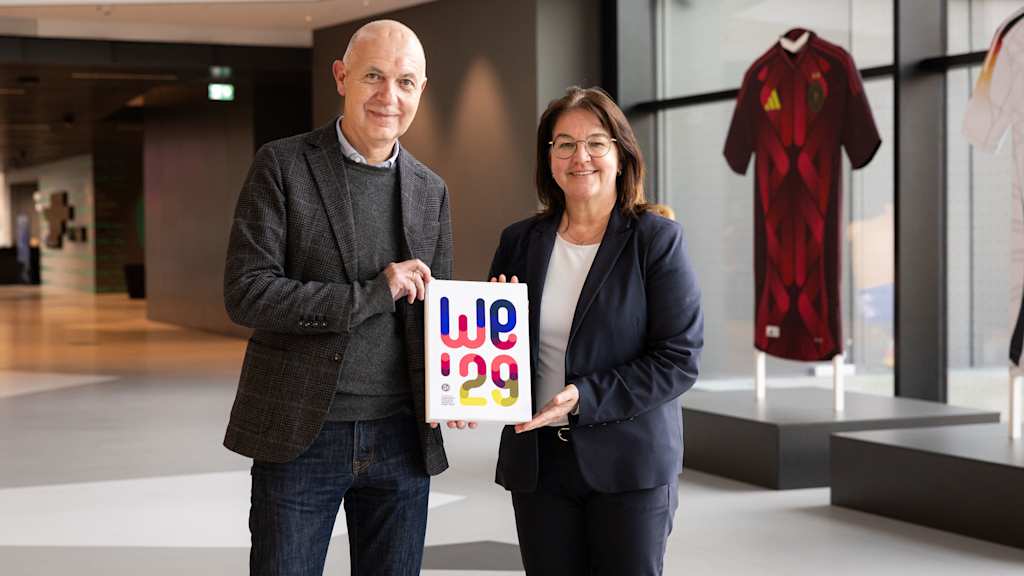
On Tuesday 26th August, the German Football Association (DFB) submitted its final Bid Dossier to host the UEFA Women's EURO 2029. DFB General Secretary Heike Ullrich, DFB Vice-Presidents Sabine Mammitzsch and Celia Šašić, and DFB Sports Director Nia Künzer personally handed over a copy of the bid book to UEFA General Secretary Theodoros Theodoridis at the UEFA headquarters in Nyon, Switzerland.
For nearly a year, numerous project groups within the DFB have worked intensively on the bid, securing the full support of the federal and state governments, NGOs, stadium operators, and the DFB’s regional associations, among others. The Bid Dossier comprises eleven chapters and approximately 650 pages, detailing the bid’s vision and impact on women’s football, proposed stadiums and host city infrastructure, and sustainability and logistical aspects including security, mobility and financial guarantees.
The heart of the DFB's ambition to host the UEFA Women’s EURO 2029 is expressed in the slogan "Together WE Rise". At an important time for women’s football, Germany aims to make the UEFA Women’s EURO 2029 tournament a catalyst for lasting economic, sporting, and social impact across all of UEFA’s National Associations.
Key to achieving this impact is the intent to sell at least one million tickets for the tournament, with seven of the eight proposed venues - Dortmund, Düsseldorf, Frankfurt, Hanover, Cologne, Leipzig, Munich and Wolfsburg - having capacities of more than 40,000. Germany also plans to use its experience in hosting UEFA EURO 2024 to unlock a variety of organisational efficiencies, with the clear target to deliver the first ever profit-making European Women’s Championship in history.
A central focus of the bid is also to increase the visibility of women’s football and women in football. Girls under 16 represent the fastest growing group of football participants in Germany, and the bid places a strong emphasis on supporting girls and women through continued grassroots development, fan engagement and leadership initiatives.
These initiatives aim to directly support the goals and objectives of Unstoppable, UEFA’s Women’s Football Strategy for 2024-2030, which seeks to create a truly sustainable ecosystem for women’s football. The significance of this commitment was underscored when an all-female DFB delegation - four leaders who have dedicated their careers to the game - submitted the Bid Dossier to UEFA.
Upon the submission of Dossier, DFB President Bernd Neuendorf said: "True to our vision, our bid is already a strong, comprehensive project for German football, involving many different stakeholders – from the top level down to grassroots. I would like to express my special thanks to our partners from the regional associations, politics, clubs, cities and stadium operators. Together, we aim to reach a significant milestone in the development of women's football in 2029. Hosting the UEFA Women’s EURO 2029 in many of our large, modern arenas - which were venues for last year’s Men’s European Championship - is a clear demonstration of this ambition. This is a unique selling point of our Bid in comparison to our very strong competition."
DFB General Secretary Heike Ullrich, added: "With last year's European Championship, we once again proved that Germany can successfully host major sporting events and that the DFB is a reliable partner for UEFA. By hosting UEFA Women's EURO 2029, we want to continue the tradition of peaceful and vibrant tournaments – and at the same time open a new chapter in women's football. Football has become more female, not only in Germany, as the membership figures of our regional associations for our association show. However, the potential is far from being exhausted. Together with UEFA, we want to break new revenue records and create even more visibility, participation and enthusiasm. This vision is at the heart of our bid book."
The host of UEFA Women's EURO 2029 will be determined by the members of the UEFA Executive Committee 3 December 2025.
About the DFB Delegation in Nyon:
Heike Ullrich
Heike Ullrich has been the General Secretary of the German Football Association (DFB) since April 2022, becoming the first woman to hold this role in the organization’s history. She previously served in various senior leadership positions at the DFB, overseeing grassroots, women’s and youth football development.
Sabine Mammitzsch
Sabine Mammitzsch is Vice-President of the DFB, responsible for Women’s and Girls’ Football. She has been a strong advocate for the expansion of participation pathways and the professionalisation of women’s football in Germany, overseeing the implementation of the DFB’s Women in Football strategy, FF27.
Celia Šašić
Celia Šašić, a former German international striker and UEFA Women’s Player of the Year, is the DFB VicePresident for Equality and Diversity. She uses her platform to promote inclusion, gender equity, and greater representation of women at all levels of the game. Šašić served as an Ambassador for the UEFA EURO 2024.
Nia Künzer
Nia Künzer, best known for scoring the golden goal that won Germany the 2003 FIFA Women’s World Cup, is now the DFB Sports Director for Women’s Football. In this role, she oversees national team strategy, talent development, and the continued growth of the women’s game in Germany.

DFB submits preliminary bid book for the UEFA Women´s EURO 2029
The German Football Association (DFB) submitted its preliminary bid documents – the so-called Preliminary-Bid Book – to UEFA for hosting the UEFA Women’s EURO 2029 on Wednesday. After six months of intensive work in numerous project groups from various departments, this marks another step on the path to UEFA's decision on the tournament's host nation due in December.
The Bid Book consists of eleven chapters that extensively address the questions set by UEFA. Among other things, the areas of vision and impact, sustainability, law, stadiums, security, mobility, logistics, and finances are covered. The Bid Book spans approximately 650 pages. UEFA will review the submitted documents in the coming months and may then raise any further clarifying questions with the bidders. The deadline for the final version of the Bid Book is the end of August 2025.
Neuendorf: "Making the EURO an economic success"
The core of the DFB's bid is the vision expressed in the slogan "Together WE Rise." The Women’s EURO is intended to generate record revenue to sustainably strengthen women’s football across Europe in all areas.
DFB President Bernd Neuendorf says: "I thank the members of the project team and all those involved from the cities and stadiums for their dedicated work over the past months. The submitted document supports our ambition to use the tournament to sustainably strengthen women’s football across Europe in all areas. We aim to welcome over a million people to our stadiums and make the UEFA Women’s EURO an economic success."
DFB Secretary General Heike Ullrich adds: "The submission of the preliminary Bid Book is another milestone. In the past months, we have worked intensively within the DFB project team and with our strong partners from the cities and stadium operators on the content. In the various areas, we were able to gather the required facts and substantiate our vision with concrete and numerous measures. For us, the preliminary Bid Book now serves as the foundation to make our bid even better in the coming months through dialogue with UEFA and our bidding partners."
125 Years of DFB – 125 Years of Football Love
The German Football Association (DFB) was founded on January 28, 1900, in Leipzig, specifically in the "Restaurant zum Mariengarten." At that time, the association had a modest 90 member clubs, but this quickly changed. Today, there are over 24,000 clubs with more than 7.7 million members. In between, the DFB has had a lively and emotional history, with many titles, tears, and triumphs. 125 years of the DFB also means 125 years of football love – for us, a reason to say "Ti amo, football!" on dfb.de/fussballliebe. On this DFB subsite, we also want to engage with fans and football enthusiasts. Here, we gather the topics that matter to you – and make them our own.
As part of an extraordinary meeting held today, Friday, the DFB Presidential Board has determined the eight venues that are going to feature in the German bid to host UEFA WEURO 2029. Coming at the conclusion of a long and thorough process, these are (in alphabetical order): Cologne, Dortmund, Düsseldorf, Frankfurt, Hanover, Leipzig, Munich, and Wolfsburg.
The Presidential Board's decision is based on the recommendations of a DFB experts' panel whose members – joined by an internal DFB working group – had examined and evaluated over the last few months the bidding documents submitted by eleven cities and stadiums that had made it on the shortlist, which had also included the bids proposed by Berlin, Gelsenkirchen, and Rostock.
Within the framework of the final selection process, the venues were divided into four categories depending on the capacity of the stadiums. The four best-rated venues in their respective stadium category were selected first. Next came the remaining four, taking into account strategic considerations previously defined in the DFB's bidding regulations, such as economic viability, the regional distribution of venues across the country and, obviously, compliance with the UEFA tournament requirements. The final list presents the best possible combination for a successful bid that will be presented to UEFA.
In an effort to ensure Fair-Play and transparency, the entire process was overseen by Ms Sylvia Schenk (Transparency International Deutschland e.V.), Sebastian Grassl (DFB Compliance Officer), and Prof. Dr Holger Preuß (Institute of Sports Science, Mainz University).
The deadline for handing in the final bid documentation for the international bidding procedure at UEFA is 27 August 2025, with the UEFA Executive Committee due to announce its decision on the 2029 European Women's Football Championship hosts in December later this year.
Says DFB President Bernd Neuendorf: "We are convinced to have made the right decision, and that the venues with which Germany enters the race for the 2029 hosting rights stand a very good chance of success. It was impressive to witness the great commitment on the part of all contenders, and we were privileged to be able to choose from eleven proposals, of which eight proved to be just a cut above the others. All this gives us some welcome tail wind and optimism for the international bidding process, and in terms of the prospective venues I think we're perfectly equipped to host another festival of football in Germany in four years' time."
DFB General Secretary Heike Ullrich adds: "On behalf of the DFB, I would like to thank all of the national bidders – they submitted top-quality, first-rate proposals that made our job anything but easy! This expressly includes Berlin, Gelsenkirchen und Rostock. At the same time, thanks are due to the persons responsible for designing and carrying out the national selection process. We are going to deliver an excellent bid to Europe and the UEFA Executive Committee and hope to be awarded the hosting rights in December 2025.
On International Women's Day today, the German Football Association (DFB) unveiled the logo for its bid to host the UEFA Women's EURO 2029. The campaign slogan is "Together WE Rise." This expresses the DFB's intention to contribute to the significant growth of women's football across Europe through the tournament in Germany.
The bid logo – WE'29 – stands not only for "Women's EURO 2029," but also for the intention to celebrate a great festival of women's football together. The vibrant colors symbolize the diversity of the continent and the optimism surrounding the future development of women’s football.
With its bid to host the 2029 Women's European Championship in Germany, the DFB aims not only to make a sporting statement. The tournament is also intended to be an economic success, generating record revenues to further strengthen women’s football across Europe.
Neuendorf: "The focus is on WE"
DFB President Bernd Neuendorf says: "The logo and slogan are key elements to make our campaign more visible and tangible. The WE takes centre stage. Through hosting the tournament, we want to give a further boost to the positive development of women’s football across Europe. A Women's EURO in Germany would definitely increase the excitement, passion, and joy for women’s football."
DFB Secretary General Heike Ullrich adds: "The logo, design, and vision fit very well with the DFB’s DNA. With our experience in organizing major tournaments and our passion for women’s football in Germany, we aim to provide an excellent stage for the tournament. The slogan 'Together WE Rise' will live on during the tournament in Germany and continue to inspire women’s football in all of Europe."
Bidding associations must submit their preliminary documents – the so-called Pre-Bidbook – to UEFA by March 12, 2025. The deadline for submitting the final version is set for the end of August 2025. The host nation will be announced by the UEFA Executive Committee in December 2025.
The Presidium of the German Football Association (DFB) has made a preliminary selection of eleven host cities – the so-called Shortlist – which the DFB will submit as part of its preliminary bid documents to UEFA by March 12, 2025, for hosting the UEFA Women’s EURO 2029.
The following eleven cities are on the Shortlist: Berlin, Dortmund, Düsseldorf, Frankfurt, Gelsenkirchen, Hannover, Cologne, Leipzig, Munich, Rostock, Wolfsburg.
Bids from Bremen, Essen, and Hamburg were not selected."
16 Teams, 31 Matchdays, 8 Venues
The tournament is set to feature 16 teams over 31 days, with matches expected to take place in eight host cities. The final selection of the host cities will be made by the DFB in June, with the final documents for the UEFA international bidding process due by August 27, 2025. The host nation for the EURO will be announced by the UEFA Executive Committee in December 2025.
To ensure an open, fair, transparent, and non-discriminatory process for selecting the host cities, the DFB conducted a national selection procedure prior to the international UEFA bidding process. The decision by the DFB Presidium followed an extensive evaluation process for all organizational aspects, covering the 14 remaining cities that participated until the end.
The evaluation of the bid documents was carried out by experts based on clearly defined and transparently understandable criteria, particularly in line with UEFA's tournament requirements. To ensure fairness, the process was monitored from a compliance perspective by Sylvia Schenk (Transparency International Germany e.V.), Sebastian Grassl (DFB Compliance), and Prof. Dr. Holger Preuß (Institute for Sports Science at the University of Mainz).
"So many attractive locations"
DFB President Bernd Neuendorf says: "My thanks go to everyone who participated in the national selection process and showed great dedication. The fact that so many attractive locations want to be part of the UEFA Women’s EURO 2029 is further evidence of the tremendous growth and potential of women’s football in Germany. Our goals are clear: We want a EURO that sustainably advances the development of women’s football across borders."
DFB Secretary General Heike Ullrich emphasizes: "Drawing up the Shortlist is the next important step in our bid process. All applicants have worked diligently, and I would like to personally thank all participants for their great commitment. Hosting a EURO would give us significant momentum for the development of women’s football not only in Germany but across Europe. We aim to sell more than one million tickets and make this the first Women's EURO in history to generate economic profit. We will continue working intensively and look forward to the next milestone in this process, the submission of the preliminary bid documents to UEFA by March 12, 2025.
15 cities have submitted their bid documents on time to be considered as host venues for the German bid to host the UEFA Women's EURO 2029. These cities and stadiums, located across Germany, are participating in the national pre-selection process.
After a thorough review and evaluation of the submitted documents, a preliminary selection of potential host cities will be made by the DFB Presidium in February 2025. The DFB must submit its preliminary bid documents for hosting the UEFA Women’s EURO 2029 to UEFA by March 12, 2025. The final submission deadline for the documents has been set by UEFA for August 27, 2025. The host nation of the tournament will be announced by the UEFA Executive Committee in December 2025.
The following cities and stadiums have submitted bids to the DFB:
- Berlin (Olympic Stadium)
- Bremen (Weserstadion)
- Dortmund (Signal Iduna Park)
- Düsseldorf (Merkur Spiel-Arena)
- Essen (Stadion an der Hafenstraße)
- Frankfurt (Deutsche Bank Park)
- Gelsenkirchen (Veltins Arena)
- Hamburg (Volksparkstadion)
- Hannover (Heinz von Heiden Arena)
- Cologne (RheinEnergieSTADION)
- Leipzig (Red Bull Arena)
- Munich (Allianz Arena)
- Rostock (Ostseestadion)
- Stuttgart (MHP Arena)
- Wolfsburg (Volkswagen Arena)
Ullrich: "High Interest is a Strong Sign"
DFB Secretary General Heike Ullrich says: "The high level of interest is a strong indication of the importance of women’s football in Germany. We are entering the next phase of the bidding process with top venues and high motivation, and we will now carefully evaluate the submitted documents. The fact that so many cities want to be involved gives us significant momentum towards our goal of bringing the UEFA Women’s EURO 2029 to Germany."
The UEFA Women’s EURO 2029 is set to be held with 16 teams over 31 days across eight stadiums.
There is great interest in the UEFA Women’s EURO 2029: 17 cities in Germany have submitted their official declaration of participation in the national selection process as part of the DFB’s bid to host the UEFA Women’s EURO 2029. The following cities and stadiums have thrown their figurative hat in the ring:
- Berlin (Olympic Stadium)
- Bremen (Weserstadion)
- Dortmund (Signal Iduna Park)
- Düsseldorf (Merkur Spiel-Arena)
- Essen (Stadion an der Hafenstraße)
- Frankfurt (Deutsche Bank Park)
- Freiburg (Europa-Park-Stadion)
- Gelsenkirchen (Veltins Arena)
- Hamburg (Volksparkstadion)
- Hannover (Heinz von Heiden Arena)
- Cologne (RheinEnergieSTADION)
- Leipzig (Red Bull Arena)
- Mainz (MEWA Arena)
- Munich (Allianz Arena)
- Rostock (Ostseestadion)
- Stuttgart (MHP Arena)
- Wolfsburg (Volkswagen Arena)
"We Move Forward Stronger in the Next Stages of the Bidding Process"
DFB Secretary General Heike Ullrich says: "We are pleased with the nationwide interest in hosting matches of the UEFA Women’s EURO 2029 and move forward with these 17 venues in the next stage of the bidding process, with the common goal of bringing the UEFA Women’s EURO 2029 to Germany."
The participating venues must submit their bid documents to the DFB by January 22, 2025. The DFB must then submit its preliminary bid documents for hosting the UEFA Women’s EURO 2029 to UEFA by March 12, 2025. The final documents must be submitted by August 27, 2025, as set by UEFA. The host nation for the EURO will be announced by the UEFA Executive Committee in December 2025.
The UEFA Women’s EURO 2029 is set to be held with 16 teams over 31 days across eight stadiums.
The Presidium of the German Football Association (DFB) has adopted the concept for the national selection process of potential host cities for the UEFA Women’s EURO 2029 during its meeting on Friday. The concept is based on UEFA's minimum requirements and was developed in accordance with the DFB’s bidding regulations. The criteria for the national selection process include the promotion of women’s and girls’ football, sustainability, and economic success. The tournament will be held in venues across Germany.
Additionally, the DFB Presidium decided to form an expert committee. The members of the committee are Dr. Holger Blask (Chairman of the Management Board of DFB GmbH & Co. KG), Jürgen Eißmann, Patrick Kisko (both Managing Directors of DFB EURO GmbH), Dr. Jörg Englisch (DFB Legal Advisor), Doris Fitschen (DFB Coordinator for Women’s Football), Pia Hess (Head of Women’s Bundesliga), Michael Kirchner (Director of Events & Operations), Nia Künzer (Sports Director for Women’s Football), and Steffen Simon (DFB Media Director).

DFB Womens Week 2025
Wir brauchen deine Einwilligung, um Inhalte von YouTube Video anzeigen zu dürfen:
"Growing like never before" - A Record-Breaking DFB Women's Week 2025
The third edition of German Football Association (DFB) Women's Week, held from 24 April to 5 May 2025, marked a major milestone in the continued rise of women's football in Germany. With record participation, sold-out stadiums, and powerful moments of celebration, the initiative underscored the DFB's commitment to advancing the women's game, from the grassroots level to the elite. Throughout the 12 days, clubs, associations, schools, and communities across Germany came together to prove one thing: the momentum behind women's football in Germany has never been stronger.
Women's Week is an initiative of the DFB to shine a special spotlight on the women's game. Central to this effort is the organisation's FF27 strategy (Frauen im Fussball), which aims to increase female participation, representation, and visibility in the sport.
By 2027, the DFB has set an ambitious target: to increase the number of female players and coaches by 25%, and to achieve a minimum of 30% female representation in DFB leadership roles. Germany's commitment to women's football is further emphasised by its bid to host UEFA Women's EURO 2029, with the ambition of delivering a landmark tournament that attracts over 1 million spectators and makes the first ever profit in UEFA Women's EURO history.
A Record-Breaking Celebration
This year's Women's Week saw unprecedented participation nationwide. From local pitches to professional arenas, the event brought together players, fans, leaders and advocates to showcase the power of women's football. The centerpiece of the celebration was the DFB Women's Pokal Final between FC Bayern Munich and Werder Bremen, held on 1 May at Cologne Stadium. In front of a sold-out crowd of 45,146, fans witnessed a thrilling 4-2 victory for Bayern. The match not only showcased the exceptional quality of women's football but also highlighted the growing public interest and fan support for the sport.
Before kick-off, a series of inspiring events set the tone for the day. The Football Association Mittelrhein (FVM) hosted ten youth tournaments, welcoming over 1,150 young girls to the pitch for a day filled with football, fun, and inspiration — a vibrant display of grassroots participation that embodied the spirit of Women's Week. On the afternoon of 1 May, the Female Brilliance event returned for its third consecutive year, offering a platform for women leaders across sport, business, politics, and media to connect, collaborate, and celebrate their contributions to the game. A lively fan fest outside the stadium added to the atmosphere, drawing supporters of all ages and turning the final into a true festival of women's football.
The results of the Women's Week were extraordinary, with an estimated reach of over 42 million on social media posts during the week, almost double that of the previous year, with engagement of almost half a million. Media reach also set new standards, with almost 8 million views on online articles and 1 million views on Women's Week-related features on television.
The Impact of Full Commitment
"The overwhelming success of DFB Women's Week — culminating in a sold-out DFB Women's Pokal Final — is proof that the passion for women's football in Germany is continuing to grow like never before" said Bernd Neuendorf, President of the DFB. "This week is more than a celebration; it's part of a broader commitment to sustained investment, increased participation, and greater visibility for women and girls at every level of the game. It is the impact of the DFB's full commitment to growing the women's game, both in Germany and across the world."
"On and off the pitch, we are fully committed to creating a more inclusive and equitable environment for women and girls in football," said Heike Ullrich, General Secretary of the DFB. "Women's Week is a powerful example of the impact we can make—but, of course, the work continues year-round. 2025 is a huge moment for women's football, with the UEFA Women's EURO in Switzerland and the awarding of the host nation for WEURO 2029—a flagship project for the DFB. We want to build on our momentum and be a game-changer for the sport in Germany and across Europe, in line with UEFA's Unstoppable strategy. We are absolutely determined to make this vision a reality."
For more information about Germany's bid for UEFA Women's EURO 2029, click here.

Foto: DFB Foto: DFB Foto: DFB Foto: DFB Foto: DFB Foto: DFB Foto: DFB Foto: DFB Foto: DFB Foto: DFB